Kashmir's Oldest Living Sharda Shrine

From the Satya Yuga to Kalhana's Rajatarangini, the wonder of Ganesh Naag, and the grand revival of 2025: the story of the Asthapan at Gund Gushi.

Origins

An Asthapan From the Satya Yuga

Goddess Sharda is a manifestation of Maa Saraswati, the presiding deity of wisdom, knowledge and learning. She holds a special place in the spiritual and cultural heritage of Kashmir, where two sacred shrines carry her worship: the ancient Sharada Peeth, in present-day Pakistan-occupied Kashmir, and Shri Sharda Asthapan of the Satyug Era at Gund Gushi, Kupwara.

The Kashmir Valley has long been revered as sacred land, home to gods, goddesses, saints, and sages. Among its many holy sites, the Sharda Mata Mandir at Gund Gushi, also known as Shardibal, in the Kupwara district of North Kashmir, stands out for its profound antiquity and spiritual significance.

Originating in the Satya Yuga, the first and purest era in Hindu cosmology, this Asthapan is the oldest living shrine dedicated to Goddess Sharda in Kashmir. Several other Sharda temples exist across the valley, and most of them emerged during the Dwapara Yuga, the era of the Pandavas. The Gund Gushi temple stands apart in antiquity, sanctity, and spiritual uniqueness. It is the most ancient Sharda Mata temple in Kashmir and among the most ancient centres of her worship in all of India.

Two Sacred Shrines

Sharada Peeth and Gund Gushi

Two shrines in Kashmir carry the worship of Maa Sharda. One lies beyond the Line of Control. The other, at Gund Gushi, is the living Asthapan where her worship continues today.

Neelum Valley · beyond the Line of Control

Sharada Peeth

Situated near the Neelum Valley close to the Line of Control, Sharada Peeth was one of the foremost centres of learning in ancient India, alongside Nalanda and Takshashila. It was a renowned seat of Sanskrit scholarship, philosophy and spiritual discourse, attracting seekers and scholars from across the Indian subcontinent.

It is one of the eighteen Maha Shakti Peethas, the place where the right hand of Goddess Sati fell.

Gund Gushi · Kupwara

Shri Sharda Asthapan of the Satyug Era

Spiritually connected to Sharada Peeth, the Asthapan at Gund Gushi occupies a place of immense sanctity in the Kashmiri Pandit tradition. Maa Sharda first manifested here, then journeyed to Tikker, and finally reached Sharada Peeth.

Devotees unable to undertake the pilgrimage to Sharada Peeth receive the same spiritual blessings by visiting Shri Sharda Asthapan at Gund Gushi.

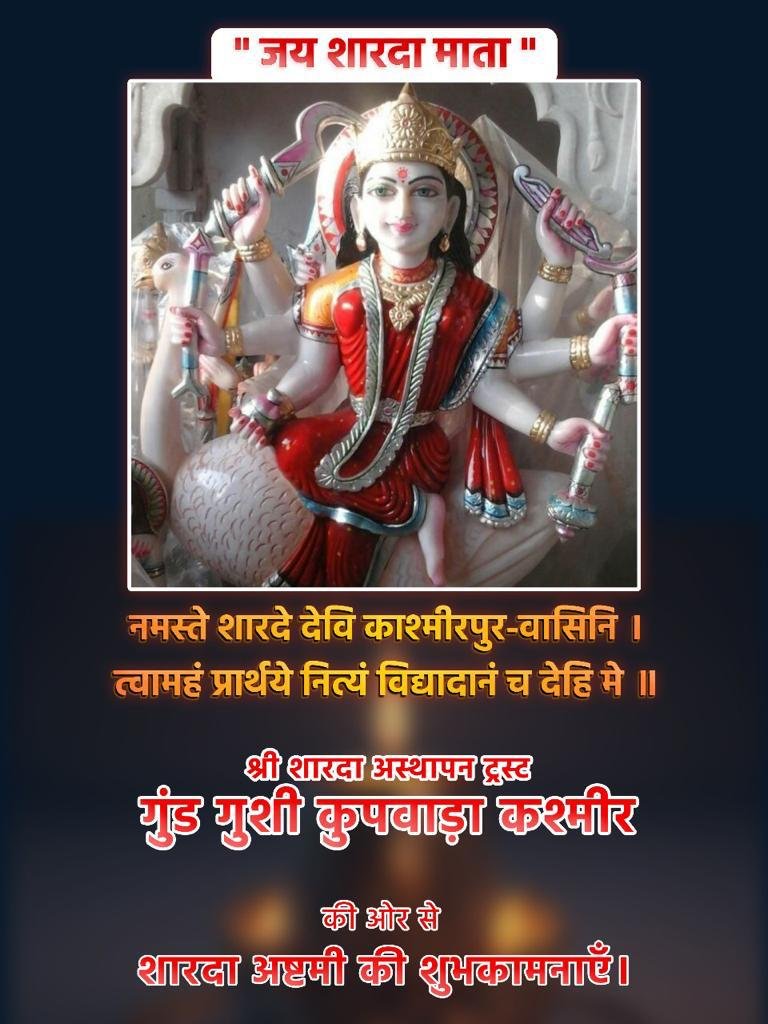
Sharda Ashtami greeting from Shri Sharda Asthapan Trust, Gund Gushi Kupwara, showing the idol of Mata Sharda and the Sharda shloka
Sharda Ashtami

A Festival of the Goddess of Learning

Sharda Ashtami holds deep spiritual and cultural significance in Kashmir, especially for Kashmiri Pandits and the devotees of Mata Sharda, the ancient Goddess of knowledge, learning and wisdom. Revered as a form of Mata Saraswati, Sharda is honoured on this day as the presiding deity of learning.

Her ancient shrines, Sharada Peeth and the Sharda Asthapan of the Satya Yuga at Gund Gushi, Kupwara, stood as major centres of spirituality and scholarship. The Gund Gushi Asthapan is spiritually linked to Sharada Peeth and holds immense sanctity in the Kashmiri Pandit tradition.

नमस्ते शारदे देवि काश्मीरपुरवासिनि । त्वामहं प्रार्थये नित्यं विद्यादानं च देहि मे ॥
Unique in All of Kashmir

The Only Temple With Dual Worship

What makes the Sharda Temple at Gund Gushi truly exceptional is that the Goddess is worshipped here in two distinct sacred forms, a combination found nowhere else in the Sharda tradition:

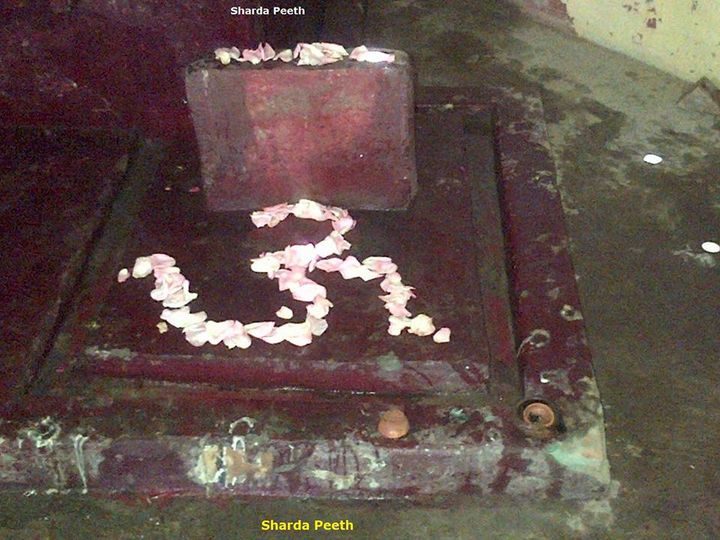
  • Shila Swaroop: a sacred Shila marking the exact spot where Mata Sharda placed her divine feet.
  • Jal Swaroop (Water Form): a holy spring near the shrine, symbolising the Goddess's life-giving and nurturing energy.

This rare dual manifestation of Maa Sharda makes the shrine unique and spiritually significant.

The Shila where Mata Sharda placed her holy feet, decorated with rose petals in the shape of Om Shila Swaroop
A Divine Journey

Gushi · Tikker · Sharda Peeth

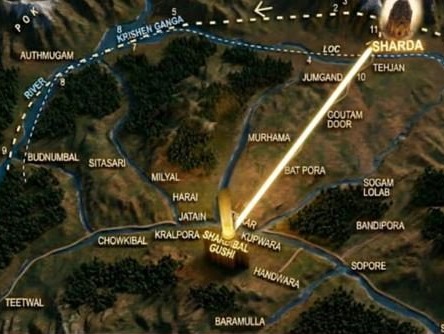
Mata Sharda first manifested at Gushi, then travelled to Tikker, and finally reached the renowned Sharda Peeth, now in the Neelum Valley of PoK. These three sacred sites lie in a perfectly straight line, a spiritual axis tracing the Goddess's journey through the Kashmir Valley.

Map showing the aligned sacred axis of Gushi, Tikker and Sharda Peeth across the Line of Control
In the Chronicles

Historical References: Kalhana's Rajatarangini

The temple finds mention in the Rajatarangini, the 12th-century chronicle of Kashmir's kings and spiritual history written by Kalhana. He refers to the village of Goshi (now Gushi), where Goddess Sharda appeared before Muni Shandilya, a revered sage, and granted him divine blessings, affirming the sacredness of the site.

Mahadevi Sharda blessed the sage with divine visions and promised to reveal her Shakti form in the sacred forest nearby, affirming the temple's sanctity. Kalhana, Rajatarangini

Scholars B.K. Raina and S.L. Sadhu, in their work Place Names in Kashmir, identify Gushi, north of Handwara in the Uttar Machipora pargana, as a significant assembly point for pilgrims heading to Sharda Peeth, where hundreds of devotees once began their sacred journey. Modern author Chander M. Bhat, in Kashmir Shrines and Temples (Vol. 2), has also highlighted the importance of this ancient temple in Kashmir's goddess traditions.

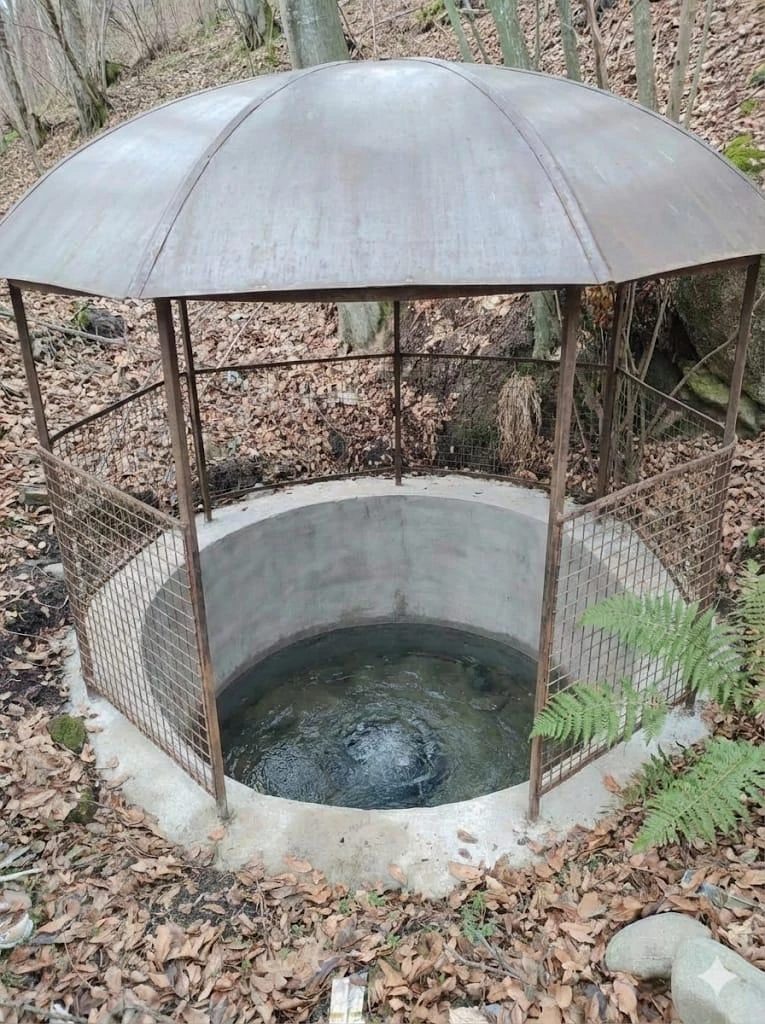
Ganesh Naag, the round spring behind the temple, under its protective canopy Ganesh Naag
The Sacred Spring

Ganesh Naag and the Birth of Reshi Pir

Behind the temple lies Ganesh Naag, a perfectly round spring approximately six feet in diameter. It has no visible outlet, yet it replenishes itself continuously and refills as soon as water is drawn, a phenomenon that has inspired devotion and wonder for generations.

Ganesh Naag is also the spring of Reshi Pir (Pir Pandit Padshah Hardu Jahan Mushkil Asaan), the revered 17th-century saint. His mother received the darshan and blessing of Maa Sharda at this spring, after smelling a flower blessed by the Goddess, and his birth followed that blessing. This further enhances the spiritual significance of the site.

Sacred Company

A Hub of Saints and Spiritual Discourse

Over the centuries, the Asthapan attracted numerous saints whose visits transformed the site into a vibrant centre of spiritual discourse and enlightenment. Before the Partition of 1947, Gund Gushi served as the starting point of the Sharda Peeth Yatra, with pilgrims gathering here before trekking onward via the Keran route.

Swami Aftab Ji Swami Kralbab Ji Swami Anand Ji Swami Ved Lal Ji Swami Baitoth Ji Swami Nand Bab (Nand Mot) and many others
Sacred Symbols

The Elm Tree of Mangal Raza

Behind the temple stands a majestic, ancient elm tree, Bren in Kashmiri. It is the abode of Mangal Raza, the village Bhairava and guardian deity of Gushi. The tree is worshipped as a symbol of divine protection and spiritual presence, and it grants protection and blessings to the village, the enduring connection between the divine and the earthly.

Inside the temple once stood a large and revered Shiva Lingam, as ancient as the Shila of Sharda Mata. During the militancy of the 1990s, when Kashmiri Pandits were forced to flee the Valley, the Lingam was damaged, a profound loss to the temple's sanctity. Throughout its history, the Asthapan has endured multiple attacks reflecting the turbulent history of Kashmir, yet the devotion of the community never faltered.

The ancient Bren (elm) tree of Mangal Raza towering behind the temple at Gund Gushi The Bren, abode of Mangal Raza
From the Satya Yuga to Today

A Timeline Across the Ages

The complete story of the Asthapan, age by age: the Goddess's first footsteps, the chronicles and the saints, the Yatra years, the exile, and the revival.

The Age of Truth
ॐ
The Origin
Satya Yuga

Maa Sharda manifests at Gund Gushi and places her holy feet on the Shila. Beside it flows her Jal Swaroop, the sacred spring. Muni Shandilya attains enlightenment here through her grace, and she guides him towards Sharda Peeth via the Sharda Forest.

The Divine Journey
Satya Yuga

From Gushi the Goddess journeys to Tikker and finally to Sharada Peeth. The three sites lie in one straight line across Kashmir. Gushi is her first abode, the oldest living Sharda Asthapan in Kashmir and among the most ancient centres of her worship in India.

The Age of the Pandavas
The Other Sharda Temples
Dwapara Yuga

The other Sharda temples of the Valley emerge in this era. Gund Gushi already stands, older by an entire yuga. Behind it, the Bren elm of Mangal Raza, the village Bhairava, keeps guard over the shrine, and Ganesh Naag, the round spring with no outlet, flows without ceasing.

Ancient and Medieval Kashmir
Sharada Peeth, Seat of Learning
Ancient India

Sharada Peeth in the Neelum Valley is one of the foremost centres of learning in ancient India, alongside Nalanda and Takshashila, a seat of Sanskrit scholarship and one of the eighteen Maha Shakti Peethas, where the right hand of Goddess Sati fell. Gund Gushi is its spiritual twin within the Valley.

In the Chronicles
12th Century

Kalhana records the village of Goshi, today's Gushi, in the Rajatarangini: the place where Goddess Sharda appeared before Sage Shandilya and granted him divine blessings.

The Saint of Ganesh Naag
17th Century

Reshi Pir, Pir Pandit Padshah Hardu Jahan Mushkil Asaan, is born after his mother receives the darshan and blessing of Maa Sharda at Ganesh Naag, the spring behind the temple.

A Hub of Saints
Across the Centuries

Swami Aftab Ji, Swami Kralbab Ji, Swami Anand Ji, Swami Ved Lal Ji, Swami Baitoth Ji, Swami Nand Bab and many other saints visit the Asthapan, making it a vibrant centre of spiritual discourse and enlightenment.

The Yatra Years
Base Camp of the Yatra
Until 1947

Gund Gushi is the principal base camp of the annual Sharada Peeth Yatra. Pilgrims from across Kashmir gather here before setting out for Sharada Peeth through the Keran route. B.K. Raina and S.L. Sadhu record Gushi as this assembly point in Place Names in Kashmir.

Partition
1947

Sharada Peeth falls on the far side of the Line of Control and the Keran route closes. The Yatra from Gushi ends. Devotees who cannot reach Sharada Peeth take darshan of Maa Sharda at Gushi and receive the same phala.

Exile and Silence
Exodus
1990s

Militancy forces the Kashmiri Pandit community to flee the Valley. The temple's ancient Shiva Lingam, as old as the Shila, is damaged. Worship falls silent.

Thirty-Six Years
1989 to 2025

For thirty-six years no Pran Pratishtha and no Maha Yagya take place at the Asthapan. The Shila, the spring and the Bren remain, waiting for the devotees to return.

Revival
Rebuilt
2019

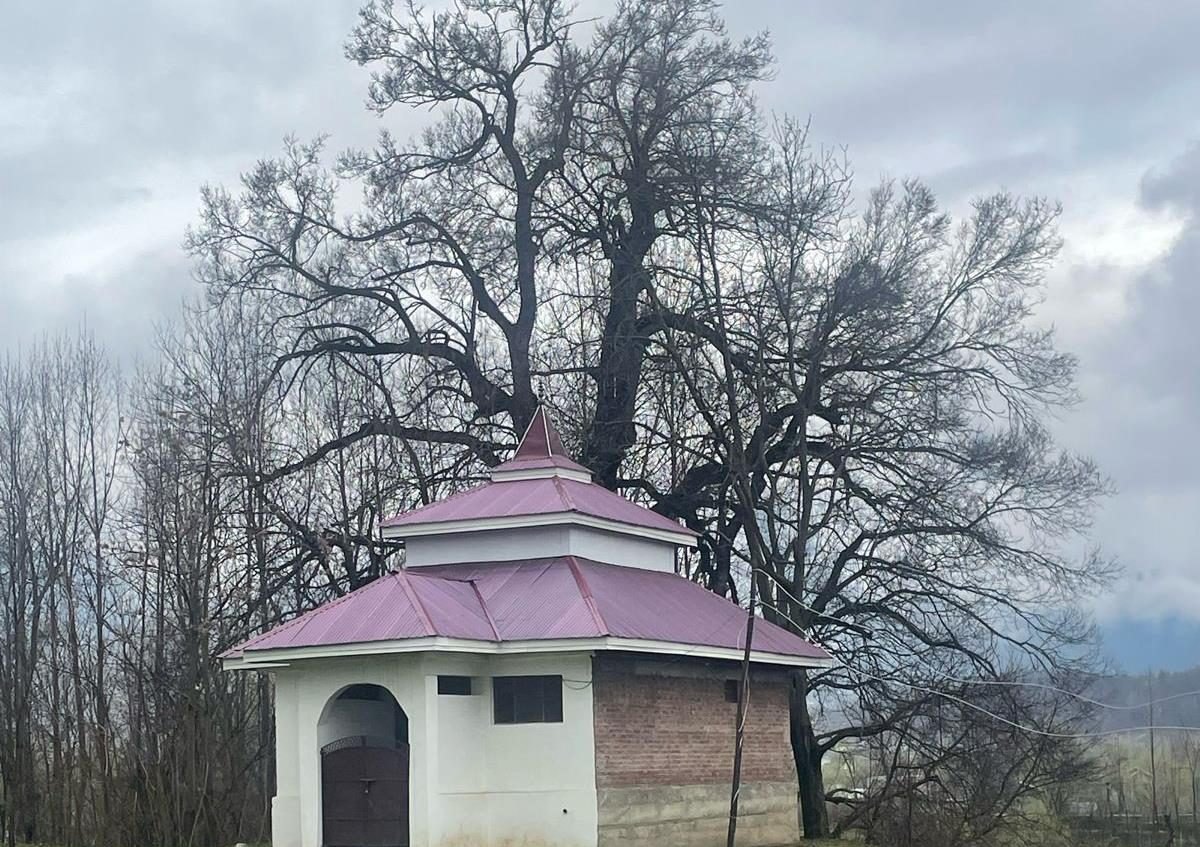
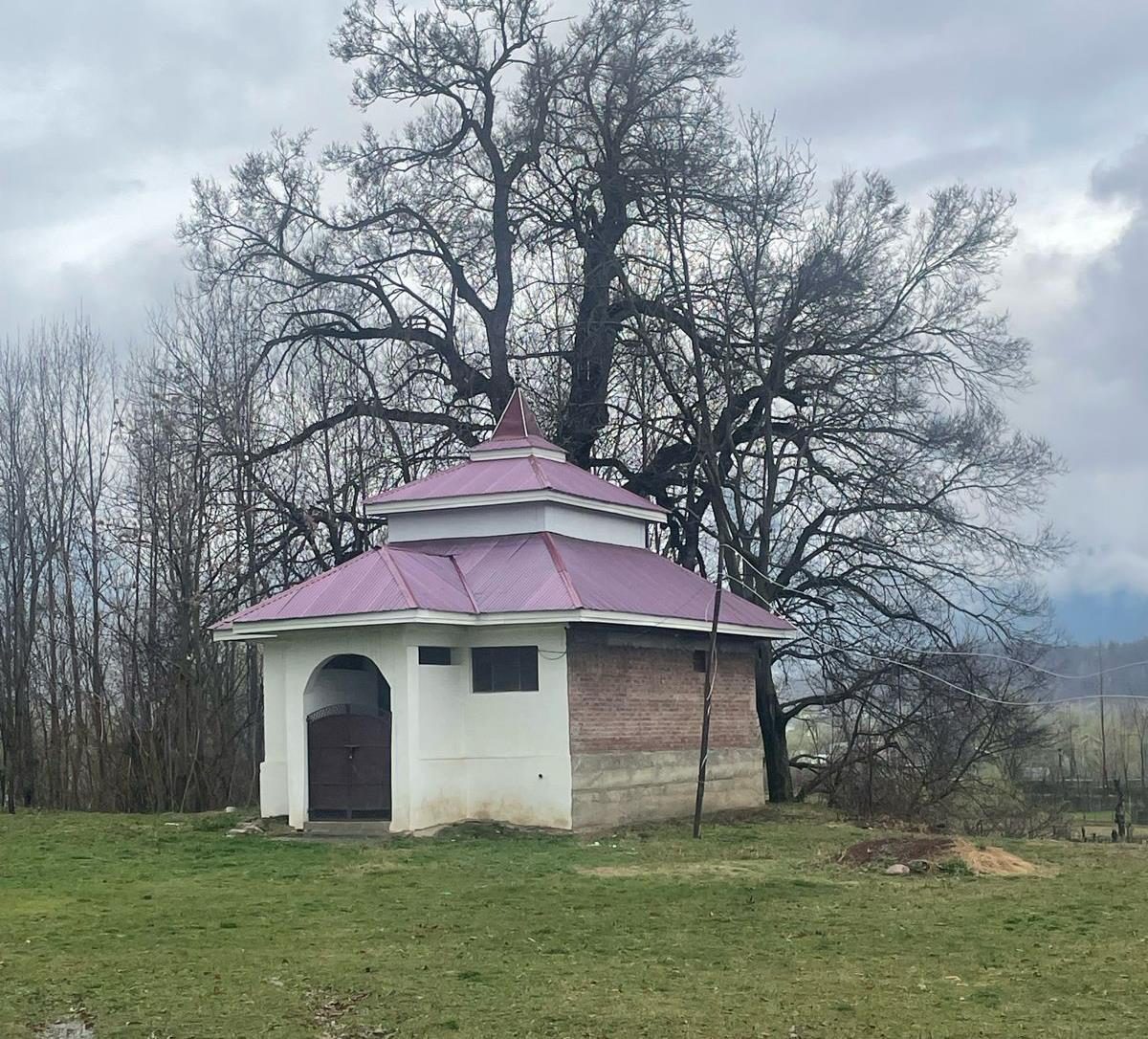
A major renovation and reconstruction project rebuilds the temple structure and restores it as a vibrant place of worship.

Pran Pratishtha
30 March 2025

The Shri Shardha Asthapan Trust performs the Pran Pratishtha, the first in 36 years, consecrating a new idol of the Goddess before hundreds of devotees who return to their ancestral village.

Trishul and Damroo
2025

A 45 kg Shiv Trishul and a 15 kg Damroo are installed at a height of 25 feet. No other temple in Kashmir has a Trishul of this scale.

Maha Yagya
31 August 2025

The annual Maha Yagya returns to the Asthapan after a gap of 36 years.

On the National Stage
24 September 2026

MyGov Hindi releases a film on the living Sharda tradition of Kupwara, tagging the Ministry of Culture and sharing it across the nation.

✦
A Living Asthapan
Today

Daily worship continues. The Trust cares for the sanctum, the Shila, Ganesh Naag and the Bren, and the Asthapan stands as a living testament to Kashmir's spiritual heritage.

The rebuilt Sharda Mata Mandir structure raised in 2019 Rebuilt sanctum, 2019
Today

An Eternal Flame of Devotion

The Sharda Mata Mandir in Gund Gushi is far more than a temple. It is a living embodiment of Kashmir's sacred traditions. From its divine origins in the Satya Yuga to its role in the Sharda Peeth Yatra and its emotional revival in 2025, the Asthapan stands as a symbol of resilience, faith, and devotion.

Its unique dual worship of Shila and Jal, its connection to ancient texts, the wonder of Ganesh Naag, and the unwavering dedication of the community make it one of the most spiritually profound places in Kashmir. Today, Shri Sharda Asthapan of the Satyug Era stands as a living testament to Kashmir's rich spiritual heritage, preserving centuries-old traditions of devotion to Maa Sharda and continuing to inspire pilgrims seeking wisdom, blessings and divine grace.

Plan Your Visit